There’s a funny thing that happens when people begin shopping for gemstones. They often assume the goal is perfection.
No inclusions.
No marks.
No quirks.
No evidence that the stone has ever experienced anything remotely inconvenient during its formation.
Essentially, we want a gemstone with the geological equivalent of an untouched résumé. But nature doesn’t work that way.
And when it comes to colored gemstones, that can be a very good thing.
Inclusions are internal features which formed within a gemstone as it grew. They may be tiny crystals, mineral needles, healed fractures, liquid-filled cavities, or other natural structures trapped inside the stone.
Some inclusions affect beauty or durability and absolutely deserve careful evaluation. Others are expected.
And some?
Some are positively wonderful.
They can reveal how a gemstone formed, help identify where it came from, create rare optical effects, or give a stone the kind of personality a perfectly clean specimen simply cannot replicate.
So, while clarity matters, perfection is not always the prize. Sometimes the magic is hiding inside.
So What Exactly Is an Inclusion?
An inclusion is any material or feature contained within a gemstone. Think of it as a tiny snapshot of geological history.
Gemstones form under extraordinary conditions: heat, pressure, mineral-rich fluids, and shifting rock formations, often over millions of years.
It would actually be rather ambitious to expect them to emerge without a scratch.
Some inclusions are visible only under magnification. Others can be seen with the naked eye. And their impact depends heavily on the type of gemstone because clarity standards are not universal.
An inclusion which might be undesirable in one gem can be entirely normal, or even prized, in another.
Emerald: Welcome to the Garden
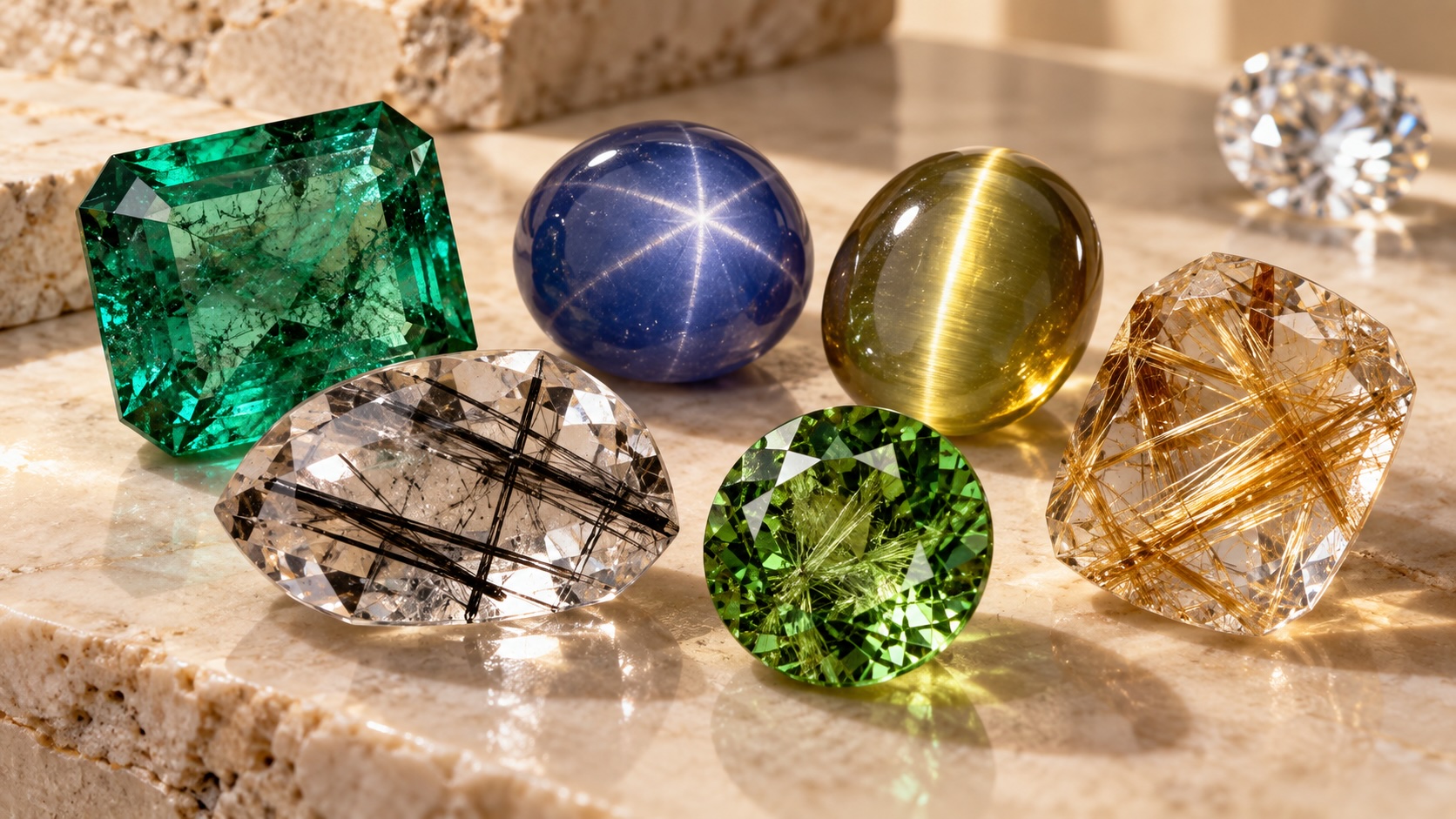
Emerald is perhaps the most famous example of a gemstone whose inclusions are not only accepted but expected.
Natural emeralds commonly contain internal features such as tiny crystals, fissures, and fluid inclusions.
Collectively, these are often referred to as jardin, the French word for “garden.” And the name is fitting.
Look closely inside an emerald, and its inclusions can resemble tiny branches, mossy landscapes, or miniature gardens frozen within the stone.
A completely flawless natural emerald is exceptionally rare. In fact, an emerald which appears suspiciously perfect deserves a closer look.
Nature is many things. Subtle is not always one of them.
The key is not whether an emerald has inclusions. The key is whether those inclusions negatively affect the stone’s beauty or durability. A beautiful emerald can have visible inclusions and still be highly desirable.
Sapphire and Ruby: Silk Can Be a Very Good Thing
Rubies and sapphires may contain extremely fine needle-like inclusions of rutile, sometimes referred to as silk. In moderation, silk can contribute to a soft, velvety appearance whicxh collectors may find very attractive.
Even more dramatically, when these inclusions are arranged in the right orientation and the stone is cut as a cabochon, they can create asterism, the star effect seen in star sapphires and star rubies.
That luminous star moving across the surface of the stone? It exists because of inclusions.
Take away the “imperfection,” and you take away the phenomenon. A rather compelling argument against perfection, if you ask me.
Demantoid Garnet: The Famous Horsetail
Demantoid garnet can contain one of the most recognizable and beloved inclusions in the gemstone world: horsetail inclusions.
These fine, wispy fibers radiate outward in a pattern that resembles, you guessed it, a horse’s tail.
In fine demantoid, particularly material historically associated with Russia’s Ural Mountains, horsetail inclusions can actually support identification and add interest for collectors.
Gemologists get unusually excited about these.
To the untrained eye: tiny fibers.
To a gemologist: Look! A horsetail!
We’re easily entertained!
Peridot: Tiny Lily Pads
Peridot often contains distinctive inclusions sometimes described as lily pads.
These are circular or disk-like stress features which can form around tiny crystals inside the gem. Under magnification, they may resemble little floating lily pads, are characteristic of peridot, and can help gemologists identify the stone.
Will most people notice them from across the dinner table? No.
Will a gemologist happily point them out under a microscope? Absolutely.
Welcome to our version of nightlife.
Chrysoberyl Cat’s Eye: The Inclusion Creates the Show
One of the most beautiful examples of inclusions becoming an asset is cat’s-eye chrysoberyl.
The glowing band of light across the stone, known as chatoyancy, is caused by very fine, parallel internal inclusions.
When the stone is cut properly as a cabochon, those inclusions interact with light to create the sharp line that appears to move across the surface like the pupil of a cat’s eye.
Without the inclusions, there’s no cat’s eye.
Sometimes nature really does hide the feature inside the flaw.
Tourmalinated Quartz: When the Inclusion Becomes the Design
Tourmalinated quartz takes things even further.
Instead of trying to hide the inclusions, this gemstone puts them on full display, with fine needles of rutile growing inside transparent quartz, creating patterns that may appear golden, coppery, reddish, or dark.
Each stone is completely individual.
The rutile may look like strands of hair, bursts of sunlight, tiny arrows, or abstract artwork suspended within the crystal.
The inclusions are not something to tolerate. They’re the entire point.
Rutilated Quartz: Nature Goes Graphic
Rutilated quartz contains dark needles of tourmaline suspended within clear or translucent quartz.
The contrast can be striking.
Some stones have just a few dramatic black needles. Others contain dense, chaotic patterns which look almost architectural.
It’s another example of a gem whose internal features are celebrated precisely because they make every specimen unique.
Perfectly clean quartz is lovely. Quartz with a personality can be even more interesting.
Not Every Inclusion Is a Good Inclusion
This is where expertise matters.
The fact some inclusions are desirable does not mean all inclusions should be ignored.
Certain fractures can weaken a gemstone.
Some inclusions can reduce transparency or beauty. Others may affect value significantly. And certain inclusions can help identify treatments, synthetics, or geographic origin.
So, the goal is not to declare inclusions universally wonderful. The goal is to understand them.
A knowledgeable gemologist looks at:
- what the inclusion is
- where it is located
- whether it affects durability
- whether it affects beauty
- whether it is characteristic of that gemstone
- whether it contributes to an optical phenomenon
- and what it may reveal about the stone’s natural origin or treatment history
Context changes everything.
Flawless Is Not the Same as Beautiful
We tend to associate perfection with value. But gemstones are a useful reminder those ideas are not always the same.
A stone can be technically cleaner and still be less interesting.
Another may contain a visible inclusion yet possess extraordinary color, character, rarity, or optical beauty. And sometimes the inclusion itself is exactly what makes the stone worth owning.
That’s why I encourage clients to look at gemstones as complete individuals rather than collections of grades.
Does the stone draw you in?
Does the color move you?
Does it have personality?
Do its natural features enhance the experience of owning something created by the earth rather than manufactured to a specification?
Perfection Is a Human Standard. Beauty Is More Interesting.
One of the things I love most about gemstones is they carry evidence of their transformation through heat, pressure, and time.
The tiny worlds inside them are reminders nature doesn’t create by eliminating every irregularity; it creates through them.
So the next time you look into a gemstone and notice something inside, resist the urge to immediately label it a flaw.
Ask what it is. Ask what it tells us. And ask whether that tiny imperfection might actually be part of what makes the stone extraordinary.
Because sometimes “perfect” is simply spotless. And sometimes imperfect is unforgettable.
Let’s connect as I’d love to tell you more about the beauty and rarity of gems and their birthmarks. This will help you choose the gem just “perfect” for you!