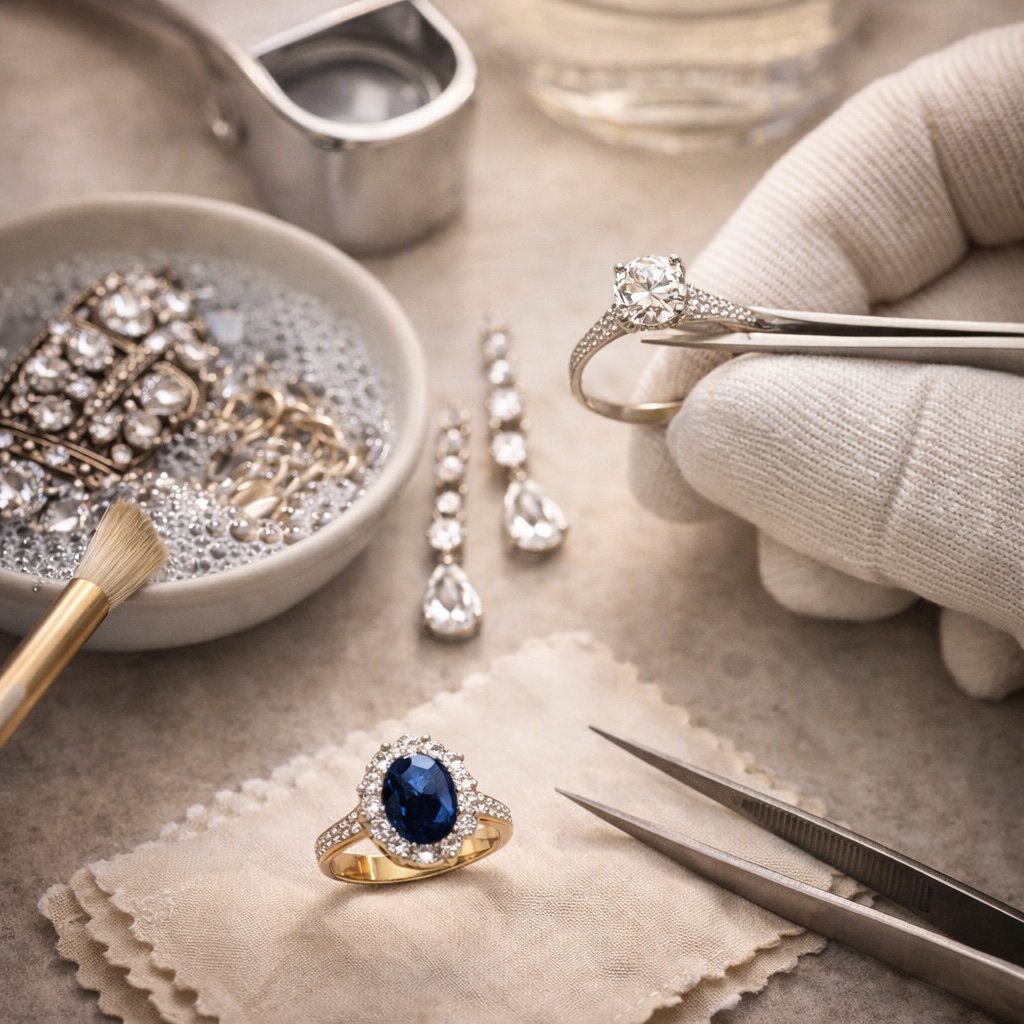
If gemstones could talk, most of them would have better stories than we do.
That emerald on your finger?
It may have crossed oceans, survived wars, changed hands in secret, sat in a velvet box for fifty years, been reset three times, inherited by someone who adored it, sold by someone who desperately needed the money, and eventually landed in your jewelry drawer beside a tangled chain from Target.
Humbling.
Unlike most things we own, gemstones can outlive us.
Gold can be melted and reworked. Settings can change. Styles come and go. But the stone itself may continue traveling from one generation to the next. One extraordinary object can pass through the hands of different owners over centuries, silently witnessing their lives as history unfolds around it.
So, let’s imagine the life of one emerald necklace.
Not a real necklace. But a very plausible one. And like most fabulous jewelry, she’s seen things.
The Priestess
Our story begins more than two thousand years ago.
An emerald is pulled from the earth in the ancient world. It’s not perfectly polished. There’s no laboratory report. No laser inscription. No velvet box with tasteful lighting.
There’s simply color. A green so vivid people believe it must hold something supernatural.
The stone eventually finds its way into the hands of a priestess named Nefara. She wears it suspended from a hammered gold collar during sacred ceremonies.
To her, the emerald is not jewelry. It’s Protection. Fertility. Renewal. A symbol of life itself.
And historically, that idea isn’t far-fetched.
Emeralds have been treasured for thousands of years, particularly in ancient Egypt, where green was associated with rebirth, vegetation, and eternal life. Cleopatra famously loved emeralds. If she had had Instagram, emeralds would have been her entire feed.
Nefara wears the stone for decades. When she dies, the necklace doesn’t go into a museum because museums have not been created yet.
Instead, it goes to her daughter.
The Daughter Who Didn’t Want It
Nefara’s daughter, Amara, is practical.
She loves her mother. She respects tradition. She does not, however, want to spend her life wearing a ceremonial gold collar which weighs approximately as much as a small boulder.
So, she keeps the emerald, but she changes it. The original gold is melted, and the stone is reset into something simpler.
And just like that, our emerald learns its first lesson: Jewelry changes because people change. We tend to think of antique jewelry as fixed objects. But historically, jewelry was constantly being redesigned. Gemstones were removed from old settings, gold was melted, diamonds were recut, and entire pieces were transformed to suit new fashions.
People didn’t always treat jewelry as untouchable history. They treated it as portable wealth.
Amara eventually passes the emerald to her own daughter. And then to hers.
Until one generation encounters financial trouble, and the emerald leaves the family.
The Merchant
Several centuries later, the emerald is sitting inside a small leather pouch belonging to a merchant traveling across the Mediterranean. This is where things get interesting because gemstones are remarkably portable. A house is valuable. A herd of cattle is valuable. Land is valuable. But none of those fit particularly well inside your sleeve.
A gemstone does.
Throughout history, jewelry has often functioned as a form of portable wealth. It could cross borders. It could be hidden. It could be traded. It could be sold quickly in times of political upheaval or financial distress.
Our emerald travels to Alexandria, to Constantinople, and on to Venice. Eventually, it reaches the hands of a goldsmith.
By now, its original setting is long gone. Its edges are worn. Its cutting style is primitive by modern standards.
But the color?
Still spectacular. That’s one of the magical things about gemstones.
The Venetian Countess
It’s now the Renaissance.
Our emerald becomes the centerpiece of an elaborate necklace commissioned for a wealthy Venetian countess. She wears it to dinners illuminated by candlelight. And candlelight is very kind to jewelry. No fluorescent bulbs. No office lighting. No overhead LEDs exposing every poor decision. Just flickering flames, silk gowns, gold thread, and gemstones glowing beautifully against skin.
The necklace is now magnificent. Pearls surround the emerald. Additional gold work has been added.
The countess wears it to court.
People gossip about her marriage.
People gossip about her husband.
People definitely gossip about the necklace.
Some things do not change. When the countess dies, the necklace passes to her eldest son, who has absolutely no interest in necklaces, but he does have gambling debts.
You can probably see where this is going.
The Necklace Gets Sold Again
The necklace appears in the inventory of a European dealer.
The pearls are removed. The gold is melted. The emerald is sold separately. This sounds horrifying to modern collectors. But again, this happened constantly.
A beautiful historic piece could disappear because someone decided: “Lovely necklace. Let’s take it apart.”
The emerald is recut. This is important. Early gemstones were often cut differently than modern ones because cutters had different tools, different priorities, and different understandings of light performance.
A cutter might reshape a gemstone to improve symmetry, remove damaged areas, enhance color, or simply make it fashionable. Every time a stone is recut, some material is lost. Our emerald gets smaller but prettier.
A familiar jewelry trade-off.
The Duchess
By the early 1800s, the emerald is living its best life.
It’s been placed into a diamond-and-emerald pendant belonging to a duchess.
This woman has opinions about everything. She dislikes one daughter-in-law. She distrusts the French. She believes dinner should be served precisely at eight. And she wears the emerald constantly.
At some point, someone tells her that emeralds symbolize loyalty and love. She approves. Mostly because she’s decided this confirms her excellent judgment.
The pendant becomes a family heirloom. It appears in portraits. It’s worn at weddings. It survives several inheritance disputes.
And then…someone puts it in a bank vault…for forty-three years. Even fabulous gemstones occasionally spend decades doing absolutely nothing.
The American Heiress
At the turn of the twentieth century, the pendant is sold.
Enter Eleanor. An American heiress traveling through Europe. Eleanor has money. New money. The dangerous kind.
She sees the emerald and immediately decides she must have it. A dealer begins explaining provenance. Eleanor is already trying it on. She buys the piece and takes it back to New York.
There, she does what generations before her have done: she redesigns it. Again. The old pendant becomes a spectacular platinum necklace with diamonds.
By now, the emerald has survived approximately seventeen aesthetic identities. It’s basically the Madonna of gemstones.
Eleanor wears it to dinners, galas, the opera, and anywhere else one might casually require a major emerald necklace.
Then the stock market crashes and suddenly, jewelry which once represented status becomes liquidity. And the necklace is sold.
The Movie Star
It’s 1948 in Hollywood.
Our emerald has excellent timing.
A jewelry house acquires it and creates a glamorous necklace featuring the stone surrounded by diamonds.
Then an actress borrows it for a film premiere, and photographers go wild. The necklace appears in newspapers.
Everyone wants to know: “Who made the dress?” “Who is she dating?” “And WHAT is around her neck?”
For one glorious evening, our two-thousand-year-old emerald becomes a celebrity. And this is where provenance can become fascinating.
Jewelry associated with important people, historic events, notable collections, or famous designers can gain value beyond the intrinsic worth of the gemstones themselves. The story becomes part of the object. The emerald is no longer simply an emerald. It has a résumé. A very good résumé.
The Woman Who Wore It With Jeans
Eventually, the necklace enters a private collection.
Decades pass. Then it’s inherited by a woman named Claire.
Claire does something radical. She wears it. Not just to galas. But to dinner, to birthday parties, and once, scandalously, with jeans and a white shirt.
Her grandmother nearly rises from the grave. But Claire believes beautiful things should be enjoyed.
She knows the necklace is valuable. She insures it. She cares for it properly. She has the emerald examined by a gemologist. And for the first time in its very long imaginary life, our stone encounters modern gemology.
Magnification. Spectroscopy. Laboratory analysis. Questions about origin. Questions about treatment. Questions about whether that tiny fissure near the corner is new or has been there since Napoleon was causing problems in Europe.
The emerald does not answer. Emeralds are discreet.
Today
Eventually, Claire’s family decides to sell the necklace, and it appears at auction.
A woman sees it in the catalog. She wasn’t shopping for an emerald necklace. But she keeps returning to the photograph. Something about the color pulls her in.
She attends the preview. She tries it on. And there it is. The same green which captivated a priestess thousands of years earlier.
She buys it and takes it home with her. That evening, she opens the box. Inside sits an emerald surrounded by diamonds in a modern setting. She sees a beautiful piece of jewelry.
What she cannot see are all the lives it might have touched before hers.
The priestess.
The daughter.
The merchant.
The countess.
The duchess.
The heiress.
The movie star.
The grandmother.
The auction house.
And now…her.
This Is Why Jewelry Is Different
Obviously, our emerald necklace is fictional. But the journey isn’t nearly as far-fetched as it sounds. Old gemstones frequently move through multiple settings, owners, countries, and generations.
Stones are recut. Jewelry is redesigned. Family pieces are divided. Collections are sold. Gold is melted. Gemstones disappear into private collections and emerge decades later. And sometimes, the person wearing an old gemstone today has absolutely no idea where it has been.
Which raises one of my favorite questions: Who owned your jewelry before you?
That antique sapphire ring? Someone may have worn it to her wedding in 1912.
That emerald pendant? It may once have belonged to another family entirely.
That old European-cut diamond? It may have been sparkling under candlelight long before electricity entered anyone’s home.
You may never know the entire story, but the clues are there.
The cutting style. The craftsmanship. The metal. The hallmarks. The setting. The wear. The treatments. The inclusions inside the stone. Every detail can tell us something.
A Gemologist Is Part Scientist, Part Detective
This is one of the reasons I love gemology. Examining a piece of jewelry is not simply about asking: “What is it worth?”
Sometimes the more interesting questions are:
How old might it be?
Has it been altered?
Is this the original setting?
Was the stone recut?
Has the gemstone been treated?
Where might it have originated?
What clues did previous owners leave behind?
Jewelry has evidence. You simply have to know how to read it. And while we may never know whether your emerald once belonged to a duchess with gambling problems in the family, we can learn an extraordinary amount from the piece itself.
Your Jewelry’s Story Isn’t Finished
Here’s my favorite part.
If you own a gemstone that’s already existed for fifty, one hundred, or several hundred years, you aren’t really the end of its story.
You’re a chapter. One day, someone else may wear it.
Your daughter. Your granddaughter. A collector. A stranger. Someone who buys it at an auction long after your name has faded from memory. And perhaps they will wonder about you.
Who wore this?
Where did she go?
What happened while this stone was around her neck?
Did she love it?
Did she wear it often?
Did she save it for special occasions?
Did she ever sit at dinner wearing a centuries-old emerald necklace with jeans?
Hopefully.
Because gemstones are durable. History is fascinating. And the best jewelry was never meant to spend its entire life sitting quietly in a box.
Every gemstone holds information within it, and sometimes the jewelry surrounding it offers just as many clues.
Whether you’re curious about an inherited piece, considering an antique jewel, or wondering exactly what has been sitting in your jewelry box all these years, a private gemological consultation can help uncover what your jewelry has to say. Let’s connect and maybe we can unravel the mystery surrounding one of your beautiful gemstones. Click HERE to book a chat.