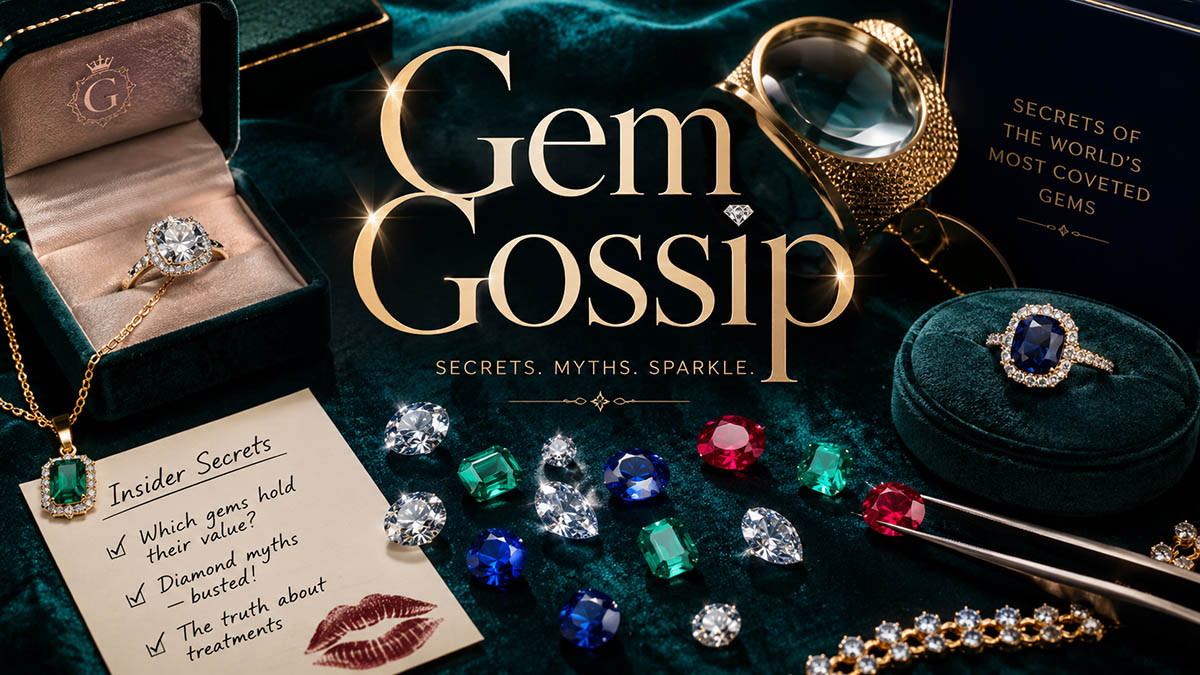
Jewelry Has Secrets
And no, I’m not talking about the mysterious disappearance of one earring from every pair you’ve ever loved.
I’m talking about the things people really want to know about gemstones and fine jewelry—but don’t always ask out loud.
Is bigger always better?
Why do two diamonds which look almost identical have wildly different price tags?
Are natural inclusions bad?
Does anyone actually understand what “carat” means?
And perhaps most importantly: can people tell when your jewelry is expensive?
As a private gemologist, I get a front-row seat to the questions, misconceptions, surprises, and occasional jewelry drama which happen behind the sparkle.
So, consider this your invitation into the “gemological group chat”.
Here are a few sparkly secrets worth knowing.
Secret #1: Bigger Does Not Automatically Mean Better
Somewhere along the way, we became obsessed with carat weight. One carat…Two carats… Three carats…
Jewelry shopping has started to sound less like romance and more like ordering produce. But carat is simply a measurement of weight, not beauty.
A larger diamond with poor proportions, dull brilliance, or an unappealing cut may be far less beautiful than a smaller stone which has been expertly cut.
In other words, a three-carat diamond can absolutely be outshined by a one-and-a-half-carat diamond.
Awkward.
Think of it like fashion. A larger dress is not automatically a better dress. The fit matters.
With gemstones, proportions, cut, color, clarity, character, and craftsmanship all contribute to what your eye ultimately sees.
The goal shouldn’t necessarily be: “How big can I get?”
It should be: “Which stone makes me unable to stop staring at my own hand?”
That’s usually the better investment.
Secret #2: The Most “Perfect” Stone Isn’t Always the Most Interesting
People often assume the closer a gemstone is to perfection, the more desirable it must be.
Sometimes, yes. But jewelry is far more nuanced than that.
Certain inclusions (those tiny internal characteristics inside gemstones) can actually help gemologists understand how a stone formed.
Think of them as nature’s fingerprints. Some inclusions may reduce value. Others are expected. Some can even create remarkable optical effects.
And occasionally, a stone with a little personality is far more captivating than one which looks technically flawless. This is especially true with colored gemstones.
A sapphire doesn’t need to behave like a diamond.
An emerald definitely doesn’t. Emeralds are basically the glamorous divas of the gemstone world. Beautiful? Absolutely. Completely free of internal characteristics? Almost never. They arrived with baggage, and frankly, we love them anyway.
Secret #3: Two Stones With the Same “Stats” Can Look Completely Different
This surprises people all the time.
You can put two diamonds side by side with very similar grading reports, and one may immediately look more beautiful to you.
Same general carat weight, with similar color, clarity, and cut grade.
Different reaction. Why? Because gemstones are three-dimensional objects, and grading reports can’t fully communicate personality.
Proportions matter.
Light performance matters.
Facet placement matters.
The location of inclusions matters.
And your own eye matters.
This is one of the reasons buying a gemstone based entirely on specifications can be tricky.
A report gives you valuable information.
It does not fall in love with the stone for you.
Secret #4: “Rare” Is One of the Most Abused Words in Jewelry
The jewelry world loves the word rare.
Rare gemstone.
Rare diamond.
Rare color.
Rare opportunity.
Rare enough that apparently you need to buy it before someone else discovers it in the next seven minutes.
But true rarity depends on a number of factors: species, variety, color, size, quality, geographic origin, treatment, and market availability.
Some gemstones are genuinely extraordinarily rare. Others are simply being marketed enthusiastically. And there’s a difference.
A good rule?
Whenever someone says: “You’ll never find another one!”
Your next question should be: “Why?”
A knowledgeable jeweler or gemologist should be able to explain what makes the piece unusual without relying on dramatic adjectives and interpretive dance.
Secret #5: Color Can Matter More Than Almost Anything Else
With many colored gemstones, color is king.
Not size.
Not clarity.
Not a complicated alphabet soup on a laboratory report.
Color.
That means hue, tone, saturation, and how alive the stone looks under different lighting.
A smaller sapphire with extraordinary blue can be significantly more desirable than a larger sapphire with gray or overly dark coloring.
The same applies to rubies, emeralds, spinels, tourmalines, garnets, and many other stones.
And here’s where things get fun. Your favorite color may not be the textbook “most valuable” color, and that’s okay.
You’re allowed to love what you love. You do not need permission from the Gemstone Olympics judging committee.
Secret #6: Lighting Is Sneakier Than You Think
Jewelry stores know something very important:
Lighting matters…a lot.
Strategic jewelry lighting can make gemstones sparkle like they’ve just received excellent news. And then you get the piece home, stand under your kitchen lights while unloading groceries, and wonder where the disco went.
This doesn’t necessarily mean something is wrong with the stone. Different light sources affect gemstones differently.
Daylight.
Warm indoor lighting.
LED lighting.
Spotlights.
Even the colors surrounding you can influence what you see.
That’s why I always recommend looking at an important gemstone under multiple lighting conditions whenever possible. If it only looks fabulous beneath twelve perfectly positioned spotlights and a chandelier worthy of Versailles, you deserve to know.
Secret #7: Expensive Jewelry Doesn’t Always Look Expensive
And inexpensive jewelry doesn’t always look inexpensive.
That’s part of the fun.
Price can reflect many things people may never notice across a dinner table, like rarity, origin, treatment, craftsmanship, designer provenance, historical significance, exceptional grading characteristics, or the quality of materials.
Which means the most valuable piece in the room may not be the largest or flashiest.
Sometimes true luxury whispers. Sometimes it enters wearing a ten-carat yellow diamond and has absolutely no interest in whispering.
There’s room for both.
Secret #8: Treatments Aren’t Automatically Bad
This is a big one!
People hear the word treated and immediately imagine someone backstage committing gemstone fraud with a chemistry set. But gemstone treatments are common and can be completely legitimate.
Heat treatment, for example, has been used for centuries to improve the color or clarity of certain gemstones.
The key issue is not necessarily whether a gemstone has been treated; the key is disclosure. You should know what you’re buying, you should understand whether the treatment is permanent, stable, or requires special care, and the price should appropriately reflect what the stone actually is.
Transparency is glamorous.
Secret #9: Your Eyes Are Allowed to Have an Opinion
This might be the most important secret of all.
People sometimes become so focused on buying the “right” jewelry they forget jewelry is supposed to create emotion.
Yes, quality matters.
Value matters.
Provenance matters.
Gemological information matters.
But after all of that, you still have to love the thing.
If you keep comparing two stones and your eye repeatedly goes back to one of them, pay attention. Your jewelry should feel like you.
Not your neighbor.
Not a celebrity.
Not a trend report.
And definitely not the person on social media who announced that anything under two carats is “basically invisible.”
We wish them well.
Secret #10: The Best Jewelry Questions Usually Begin With “Why?”
Why is this sapphire more valuable?
Why does this diamond sparkle differently?
Why is this emerald included?
Why does this designer command a premium?
Why is this antique piece significant?
Why is this gemstone considered rare?
The more questions you ask, the more interesting jewelry becomes. Because behind every beautiful stone is geology, chemistry, craftsmanship, economics, history, artistry, and human fascination.
Which is why jewelry collecting can become slightly addictive.
You start by thinking: “I’d just like a nice pair of earrings,” and three years later, you’re casually discussing untreated Kashmir sapphires over lunch.
It happens.
The Best Gem Gossip? Knowledge Makes Jewelry More Fun
Learning about gemstones doesn’t take away the romance. It adds to it.
Once you understand what you’re looking at, you begin noticing details you would have otherwise missed. The richness of a color, the precision of a cut, the rarity of a material, the hand of a great designer.
And suddenly jewelry becomes more than something beautiful. It becomes fascinating!
That’s the real secret behind becoming a knowledgeable collector; the more you know, the more there is to love. And unlike most gossip, this kind actually makes you smarter.
Whether you’re considering an important purchase, evaluating a piece in your collection, searching for something extraordinary, or simply want an expert eye before making a decision, working with an experienced private gemologist gives you something invaluable: clarity.
Because when the jewelry is expensive, the sparkle should never be the only thing dazzling you.
I’d love to connect with you to talk “gem gossip” and help you find the perfect diamond or gemstone for you. You’re on your way to becoming somewhat of a gem expert already…I can help you fine tune your knowledge. Click HERE to book a chat.